
How do you care for fragile edges without making them worse?
If your edges are already thin, weak, or breaking easily, the first thing to do is stop treating them like an area that needs to be “fixed” aggressively.
Fragile edges usually need the opposite.
They need less tension, less manipulation, less pulling, and more gentle, consistent care.
That means being careful about how you style your hair, how you detangle it, how often you brush your hairline, and even how you moisturise the area.
And if your edges are already struggling, the products you use should support that gentler routine rather than encourage you to keep touching, brushing, slicking, and restyling them.
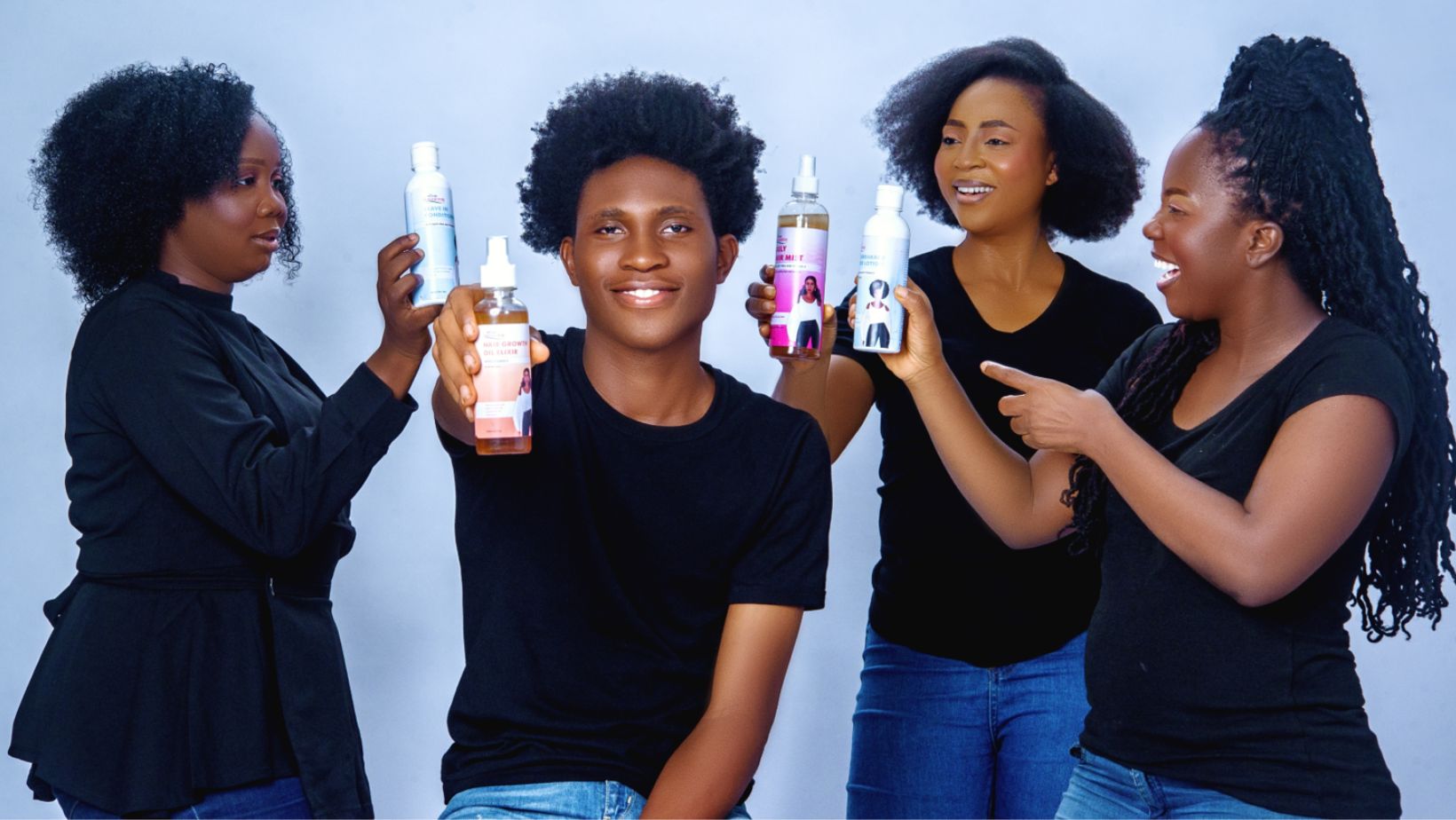
For example, an African Naturalistas Fertile Edges Set is designed specifically around caring for fragile and thinning edges. But you can also support your overall routine with products such as the Leave-In Conditioner, Daily Hair Mist, Deep Conditioning Mayonnaise, and Hair Growth Oil Elixir.
The important part, though, is understanding how you care for fragile edges, not simply finding another product to put on them.
And that starts with something many people overlook: your edges are not separate from the rest of your hair routine.
Your edges are part of your hair, too
It sounds obvious, but it changes the way you care for them.
Your hairline is still made up of hair strands growing from follicles in your scalp. Those hairs are often finer and more vulnerable to repeated tension and manipulation, which means the way you treat that area matters.
Think about what your edges go through.
You brush them.
You smooth them.
You lay them.
You pull them into ponytails and buns.
You may use gels or edge controls on them.
You may tie your scarf tightly to keep them flat.
Then you do it again the next day.
None of these things automatically means you're damaging your edges. The problem is what happens when tension and manipulation become a constant part of your routine.
So before reaching for another product, let's look at the habits surrounding your edges.
Because sometimes the biggest improvement you can make is simply doing less.
If your edges are fragile, stop pulling on them
This is probably the most important place to start.
If your edges are already thinning or breaking, constantly pulling them into place isn't going to give them much opportunity to recover.
That includes very tight:
- Ponytails
- Buns
- Braids
- Cornrows
- Sew-ins
- Wigs secured too tightly
- Slick-back styles
And it isn't only the finished hairstyle that matters.
Think about what happens while you're creating it.
If you're repeatedly brushing your hairline backward, pulling small hairs into a style, or using considerable tension to get every strand perfectly smooth, your edges are experiencing that tension before you even leave the house.
This is why “protective” doesn't automatically mean “healthy.”
A style can protect your hair from daily manipulation while still putting too much tension on your hairline.
So if your edges are fragile right now, ask yourself:
Can I create this style without pulling my edges so tightly?
If the answer is no, it may be time to give that style a break.
And then there's the brushing
Let's talk about something that seems harmless because it only takes a few seconds.
Brushing your edges.
Many people have a specific brush reserved for getting their hairline perfectly sleek. They brush backward, forward, sideways, add more product, brush again, and keep going until every little hair is exactly where they want it.
But if your edges are already fragile, repeated brushing can become another source of unnecessary manipulation.
You don't need to completely stop styling your edges.
You just need to stop expecting them to look perfectly laid every single day.
Sometimes a softer, less manipulated hairline is a healthier-looking hairline.
And if you need to refresh the area, use your fingers where possible and handle the hair gently rather than repeatedly brushing it into submission.
That brings us to another important part of edge care: moisture.
Fragile edges still need moisture—but don't confuse moisture with more product
Dry hair is generally more prone to feeling rough and becoming difficult to handle.
And when hair feels difficult to handle, what do we often do?
We manipulate it more.
We brush it more.
We pull at it more.
We add more product.
And suddenly a simple dryness problem has become a manipulation problem too.
This is where something as simple as a Daily Hair Mist can fit into a routine. It provides lightweight moisture that can help refresh dry hair without requiring you to completely restyle it.
A Leave-In Conditioner can also be useful as part of a moisture-focused routine, particularly when your hair needs softness and manageability after washing.
The goal isn't to keep applying product to your edges all day.
The goal is to keep the hair in a condition where you're not constantly fighting with it.
And if your hair is generally dry, there's another step worth paying attention to: conditioning.
Don't wait until your edges are breaking to think about conditioning
Your edges are part of your overall hair, so your wash-day routine matters too.
If you're shampooing, conditioning and deep conditioning the rest of your hair while completely ignoring the hairline, you're missing part of the picture.
A regular deep-conditioning routine can help improve the softness, manageability and condition of dry or stressed hair.
The Deep Conditioning Mayonnaise is designed to deep condition dry and damaged hair while helping improve softness, strength and elasticity.
That doesn't mean you should pile deep conditioner onto your edges every day.
It means that your edges benefit from being included in a thoughtful overall hair routine.
And once wash day is done, the next question becomes: what happens between wash days?
Your edges don't need to be touched every day
This is one of the simplest changes you can make.
You don't need to inspect your edges every morning.
You don't need to brush them into a new style every day.
You don't need to keep adding products because they don't look exactly how you want them to look.
Sometimes, the best thing you can do after moisturizing your hair is leave it alone.
This is especially important if you're already noticing:
- Short broken hairs around your hairline
- Thinning areas
- Increased shedding around the edges
- Tenderness after styling
- Hair that seems to be getting shorter around the hairline
- Difficulty keeping your edges in place because the area has become sparse
Your routine should respond to what your hair is telling you.
If your edges are telling you they're tired, listen.
Be careful with “laying” your edges
There is absolutely nothing wrong with wanting your edges to look neat.
But there is a difference between styling them occasionally and making perfectly laid edges part of your everyday identity.
If you need strong hold, repeated brushing, pulling and reapplication to maintain the look, your edges are paying the price for that consistency.
Try giving yourself permission to have days when your edges are simply soft, moisturised and natural.
You don't have to make them disappear.
You don't have to make them perfectly sleek.
You don't even have to style them.
Your hairline can simply exist.
And if you're someone who loves protective styles, the same principle applies.
Protective styles should protect your edges, too
This is where many routines become confusing.
You put your hair into braids because you want to protect it.
But if the braids around your hairline are extremely tight, your edges may be under more stress than the rest of your hair.
Pay attention to how your scalp feels immediately after installation.
If the style feels painfully tight, gives you a headache, causes soreness, or makes your hairline feel like it's being pulled, that's important information.
A protective style shouldn't require you to ignore discomfort just because it looks neat.
When your edges are already fragile, ask your stylist to work with less tension around the hairline.
And if a particular style consistently leaves your edges thinner, consider taking a break from it.
What about hair growth oils?
This is where expectations matter.
An oil can be part of a healthy hair-care routine, but it isn't a substitute for reducing the things that are damaging your edges.
You can't repeatedly pull, brush and tightly style your hairline and then expect an oil to completely cancel that out.
The Hair Growth Oil Elixir can be incorporated into a scalp and hair-care routine to nourish the scalp and strands and support healthier-looking growth.
But think about it this way:
The product supports the routine. The routine supports your hair.
It shouldn't be the other way around.
If your daily habits are working against your hairline, adding another product won't necessarily solve the underlying problem.
And if breakage is happening beyond your edges, look at the bigger picture
Sometimes fragile edges aren't the only sign that your hair needs gentler care.
You may also notice:
- More hair on your comb
- Short broken pieces around your shoulders
- Split ends
- Hair that feels increasingly dry
- Difficulty retaining length
- Excessive tangling
- More breakage when detangling
When several of these things are happening together, it may be time to look at your entire routine rather than focusing only on your edges.
That's where a product such as Breakage Be Gone can fit into a broader breakage-focused routine.
The idea is simple: don't treat one symptom while continuing the habits that are causing stress elsewhere.
If you have children, their edges deserve the same gentleness
Children's hairlines can also be delicate, especially when hair is frequently styled, brushed or pulled.
The routine doesn't need to be complicated.
Gentle cleansing, conditioning, moisture and careful detangling can go a long way.
For younger hair, the Early Starters Natural Hair Shampoo is designed to gently cleanse children's hair while leaving it moisturised.
After washing, the Early Starters Leave-In Conditioner can help with moisture, softness, manageability and easier detangling.
And that last part matters more than people sometimes realise.
Because every time you fight through a knot, you're creating another opportunity for unnecessary pulling.
Make detangling easier before your edges pay the price
You don't want to discover that your hair is tangled and then attack it with a comb.
Especially around the hairline.
Instead, give the hair some slip first.
Work in sections.
Use your fingers where possible.
Start from the ends and gradually work your way upward.
And when you get to the edges, slow down.
Those tiny hairs don't need to be rushed.
If your overall routine is difficult to manage, something like the Stubborn No More routine can help make natural hair more manageable through cleansing, conditioning, moisture and detangling support.
Again, notice the pattern here.
We're not looking for one magical edge product.
We're creating conditions where your hair has less reason to be pulled, forced and manipulated.
Sometimes the simplest routine is the one you'll actually follow
At this point, you might be thinking:
“Okay, but what am I actually supposed to do?”
Keep it simple.
A fragile-edge routine can look something like this:
1. Cleanse gently.
Don't scratch aggressively or rough up the hairline when washing.
2. Condition.
Give your hair softness and manageability after cleansing.
3. Deep condition regularly.
Especially if your hair is dry, brittle or difficult to manage.
4. Keep your hair moisturised.
Use a leave-in or lightweight mist when your hair needs refreshing.
5. Reduce tension.
Loosen tight styles and avoid repeatedly pulling the hairline.
6. Reduce daily manipulation.
Your edges don't need to be brushed and restyled every morning.
7. Handle your hair gently.
Especially while detangling.
8. Give your edges time.
Hair care is not usually about seeing a dramatic difference overnight. Consistency matters.
And if you don't want to figure out which products belong together, the Starter Pack can provide a more complete routine rather than forcing you to build everything from scratch.
Your edges don't need to look perfect every day
This might be the most important thing to take away.
We have become so used to perfectly laid edges that we can forget that hair is supposed to grow from our scalps—not stay glued down to them.
Your edges don't need to be perfectly sleek every morning.
They don't need to match your hairstyle perfectly.
They don't need to withstand constant brushing just to look “done.”
If your hairline is fragile, less can genuinely be more.
Less tension.
Less pulling.
Less brushing.
Less restyling.
More moisture.
More gentleness.
More consistency.
And if you are dealing with significant or progressive thinning, bald patches, pain, inflammation or persistent hair loss around the hairline, don't assume it's simply a styling issue. It can be worth speaking with a qualified dermatologist or trichologist to understand what's actually happening.
Healthy edges aren't created by forcing them to behave.
They're supported by giving them an environment where they don't have to keep fighting for survival.
FAQs About Caring for Fragile Edges
How can I make my fragile edges stronger?
Start by reducing the things that repeatedly stress them, especially tight hairstyles, excessive brushing and frequent manipulation. Keep the hair moisturised and incorporate gentle cleansing, conditioning and careful detangling into your routine.
Should I stop laying my edges if they are thinning?
You don't necessarily have to stop styling them completely, but if laying your edges requires repeated brushing, pulling or strong tension, it may be helpful to reduce how often you do it and give the area more time without manipulation.
Can tight hairstyles damage your edges?
Yes. Repeated tension from tight braids, ponytails, buns, extensions and other hairstyles can contribute to hairline stress and breakage. If a style consistently causes pain or noticeable tension around your edges, it's worth reconsidering how tightly it's installed.
Is hair oil enough to repair fragile edges?
Hair oil can be part of a supportive hair-care routine, but it shouldn't be treated as a solution that cancels out constant tension or manipulation. Your overall routine and styling habits matter too.
How often should I moisturise fragile edges?
There isn't one schedule that works for everyone. Pay attention to how your hair feels. If your edges become dry, a lightweight moisturising product such as a leave-in or hair mist can help refresh them without requiring excessive manipulation.
Can brushing my edges every day cause breakage?
Frequent brushing can contribute to unnecessary manipulation, particularly if you're applying tension each time. If your edges are already fragile, try using your fingers more often and reducing how frequently you brush them into place.
What should I do if my edges keep getting thinner?
First, look at the amount of tension and manipulation your hairline experiences. Also consider your styling habits, extensions, braids, wigs and how often you brush or pull the area. If thinning continues or you notice bald patches, pain or inflammation, consider getting professional advice to identify the underlying cause.
Can children experience fragile edges too?
Yes. Children's hair can also become stressed from tight hairstyles, frequent brushing and rough detangling. A gentle routine using appropriate cleansing, conditioning, moisture and low-tension hairstyles can help reduce unnecessary stress on the hairline.
What is the most important thing to remember about fragile edges?
Don't make a fragile area work harder.
If your edges are already weak, the goal isn't to manipulate them more aggressively. The goal is to create a gentler routine that gives them less tension and more consistent care.